

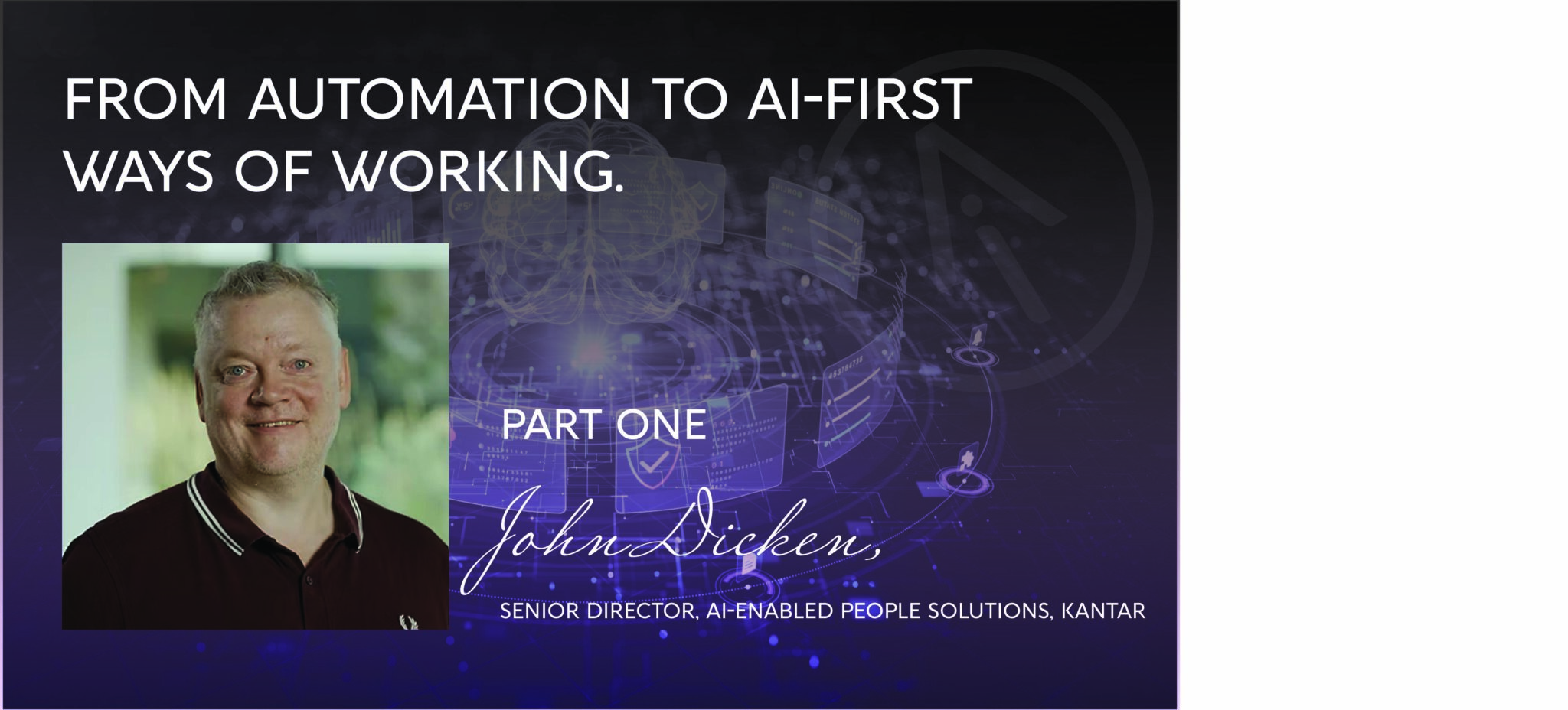
By John Dicken, Senior Director, AI-Enabled People Solutions, Kantar
Every HR leader I talk to is doing something with Copilot – drafting faster, summarising a policy, tidying a spreadsheet. All useful. None of i on it’s own tells you where your real AI opportunity sits.
Here is the distinction that changed things for me: using AI to do today’s process a little quicker is not the same as asking whether that process should exist in its current shape at all.
Most teams start with the first – it is visible, it is fast and it helps people understand the potential of these new AI capabilities we all have access to. But point Copilot only at your existing workflow and you get a faster version of a process built for a world without AI. You have automated the past.
The better question, worth starting with is: if you designed your team’s work today, knowing what AI can now do, would it look like what you have?
A practical exercise you can run this week
You do not need a strategy offsite. You need twenty minutes, Copilot, and an honest list of what your team does day to day.
Try asking: “Here is what my team does in a typical week [paste a rough list]. For each activity, tell me whether this is transactional, rules-based execution, or work depending on judgement, empathy, or ambiguity, or combinations of.”
What comes back separates your team’s work into two honest piles. One is process repeatable, rules-bound and a genuine candidate for AI to execute end to end. The other is human wisdom reading a room, weighing competing needs and judgement that no policy covers.
For the first pile, the question becomes: how do we redesign this so AI does it by default, only handing off to people when needed?
For the second: how do we free up more time for it by taking the process work away?
Why this matters before the technology conversation
This is deliberately not a technology conversation yet – it is a design one. In my own team, the biggest shifts came not from picking an agent platform, but from being honest about which activities were legacy habits dressed up as necessary process, and which genuinely needed a human.
Get that separation right first, and the technology choice becomes far easier.
Next in this series
In article two, I will share a genuine “no-regrets” move from our own journey – fixing inconsistent, outdated knowledge using agents and how it ended up in one of Microsoft’s own customer stories.
If you would like to explore this in person, Jordan Mori from Argon and I will be hosting a small, invite-only round table for CPOs and HR leaders on AI in HR on 15 October, where we will be going deeper into moving from isolated experiments to a genuinely redesigned way of working.
You can find out more about the event here.

 Home
Home How We Help Clients
 What We Do
 Who We Are
 Our Events
 In the Community
 Our Insights & News
 Our Clients